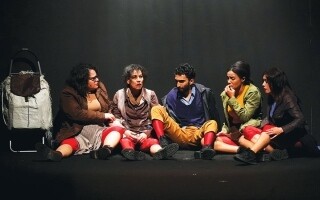
In the space of a transportation station in Tunisia, writer and director Faouzia Taboubi presented her play 'The Runaways,' which has won numerous theatre awards, the latest being the Sheikh Dr. Sultan bin Muhammad Al Qasimi Award for the best Arab theatrical work at the 16th Arab Theatre Festival. Through her work, the Tunisian artist explores the pressing reality faced by the characters of 'The Runaways' and their waiting that transcends spatial movement, turning into a search for an outlet from the narrowness of life, an escape from a bitter reality. In the play, presented by the Tunisian National Theatre and opening the 35th Sharjah Theatre Days festival, which started on March 24 and continues until the end of the month, there are six characters: five women and one man. The women are a teacher searching for professional recognition, a law graduate waiting for her chance, a woman fleeing a suffocating marriage, another collecting plastic bottles to secure her livelihood, and a marginalized elderly woman, while the man is a character weighed down by disappointments. Black comedy was a dramatic and strategic choice in writing the text to connect the characters and their relationships. When she searched for fragile characters and works, she found that the majority of them are carried out by women. This is how 'The Runaways' came to be—five heroines and one man united by the Tunisian production that opened the Sharjah Theatre Days. Faouzia Taboubi noted that when she searched for fragile characters and works, she found that the majority are carried out by women, whether they are housewives, cleaners, or workers in sewing workshops, while men represent a small percentage of marginalized workers. In her work, Faouzia Taboubi uses black comedy, showing that at the peak of tragedy, comedy and laughter emerge from the characters' pain. This highlights how these strong characters are stronger than their reality; they laugh at their pain and try to transform it into a better life. They are amusing characters that make the audience laugh at them and at themselves. The director and writer emphasized that black comedy was a dramatic and strategic choice in writing the text and connecting the characters, which is the most difficult approach as it requires vigilance and the ability to grieve and laugh at the same time. Responding to the 'repeated crisis,' Faouzia Taboubi confirmed that since the beginning of her career in theatre, she has been hearing the phrase that there is a crisis in theatre and in texts. She noted that she still hears the same phrase today, which she rejects. She stressed that there are always flaws and mistakes, but at the same time, there is experimentation and effort, and theatre people have the right to experiment, to make mistakes, to engage with theatre, and to ask questions. She mentioned that Arab peoples love the verbal text and prefer speech, even though the Arab person today has become more silent and hides much in their body. Regarding the scenography, which represented a public space and did not clearly present the station to the audience, relying on coding and anatomy, Faouzia Taboubi explained that there were many tools on stage that indicated the station and transit, but these signs reflected the characters' psychology, including road signs like 'under construction' and 'no entry,' all of which pointed to the characters' journey and guided their movement. Regarding the title 'The Runaways,' which is a feminine plural despite the presence of a man in the play, she believes that the linguistic rule that requires using the masculine plural when adding one man to a group of women is unfair. Numbers are always fair, but the language, which is controlled by humans, is not. The characters gather in an undefined space on stage that takes us to something resembling a station that brings these souls together, transforming into a mirror that reflects the fragility of society and gives voice to the marginalized. Answering a question about 'The Runaways' winning the award for the best Arab theatrical play, Faouzia Taboubi said in an interview with 'Al-Ittihad Al-Youm': 'I am happy that the play won the award, but I do not work for awards, I work seriously on the subject. The project is permanent, it is not linked only to this play, and there will be other plays to follow. I am delighted that this project has been crowned with many awards, which encourages and supports me and the team, and strengthens our efforts and makes us more steadfast on the path we have chosen.' She added about the meaning of 'escape' in the play: 'The play brought together many symbols, from the title to the aesthetic choices, the type of presentation, and the verbal and physical text, to attract today's audience, who no longer care about theatre and is more fascinated by social media. It is an attempt to escape the noise of the world and the different feelings we live without understanding our reality, especially this violent rhythm that humans live in the world, whether at work or in daily life. There are tensions and unexplained tension, and all of this is translated through art.' The artist believes that theatre dissects the human being and their worries; there is an attempt to understand the self, its ideas, and its anxieties. She works to ask questions loudly, not to offer solutions. Questions can change something in the spectator's perception and make him ask many questions about the purpose of his life, work, and the exhausting and tiring daily routine. In addition to the verbal text, Faouzia Taboubi created a physical text in the play, stressing that she always seeks through her works to establish the concept of the physical text in theatrical performances. She is convinced that the theatrical text is not only words; there is a physical text that conveys many feelings and emotions through the language of the body and face. One must listen to the tired body and create tools that enable it to express itself, to complement the verbal text. She rejected comparing the physical text to 'choreography,' not every moving body is a dance; there are bodies that express dramatic action, and this is what makes movement a text in itself, helping the spectator to understand the play without words. She believes that theatre that does not carry a thought is a simple, shallow, and insincere theatre.